Zoltan Borbereki, Christo Coetzee, Rory Emmett, Cecil Higgs, Robert Hodgins, Sam Nhlengethwa, Blessing Ngobeni, Cinga Samson, Lucas Sithole, Cecil Skotnes, Harry Trevor, Edoardo Villa, Asha Zero
“WALL presents works by South African artists who built the foundation for future aesthetic developments in the South African art.”
Women have historically played pivotal roles in the evolution of the visual arts in South Africa. As artists then and today the contribution of women has been significant and remains such today. South African art history in the early twentieth century is almost dominated by woman painters with the likes of Irma Stern, Maggie Laubser, Maude Sumner, Florence Zerffi, Nita Spilhaus, Freida Lock actively challenging the stereotype of the women painting as a domestic hobby. All of them were professional in the approach to painting and saw their work as contribution to an evolving new modernist tradition. That critics in many instances baulked at their innovative approaches to their subjects and dismissed these as aberrations is not surprising. The challenge these women presented to the male dominated status quo of the artworld at the time, was no less than a challenge of patriarchy. Although many of these women would deny any feminist consciousness their assertion of their place in the art world through a professional commitment to their art can be seen as consistent with the growing feminist expressions at the time.
Art history has still not fully acknowledged their contribution, but as collectors begin to realise their significance a reconsideration and reevaluation of women artists’ contribution to the fine arts is beginning to be realised and focussed on more acutely than before. It is within this context that WALL is pleased to present a selection of iconic works by women artists from the mid to late twentieth century.
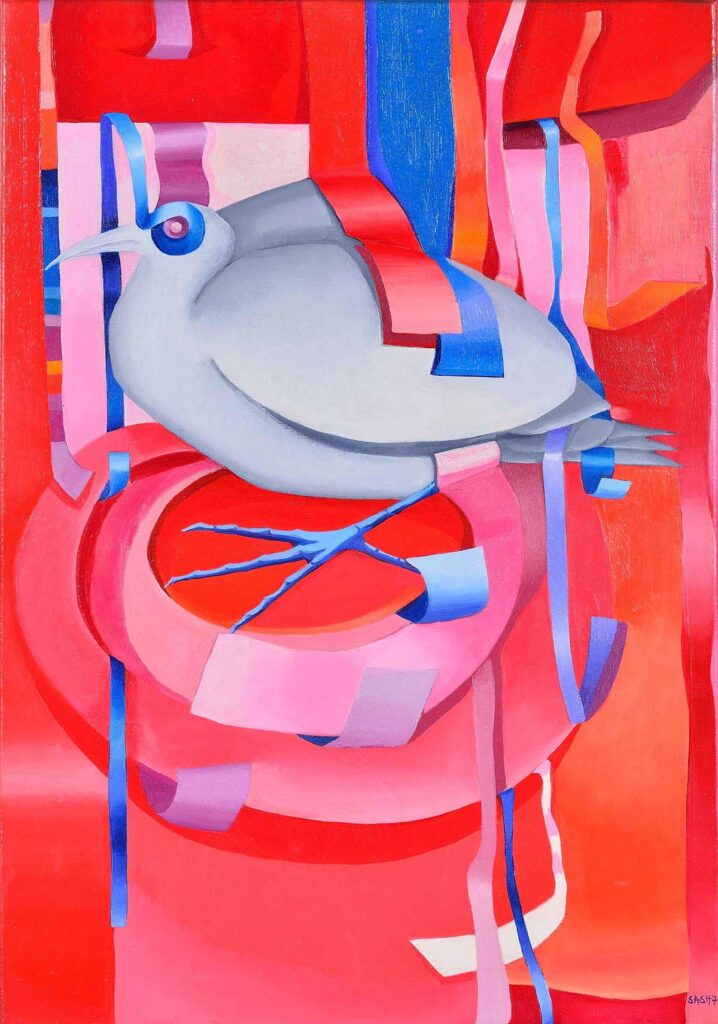
Cecily Sash, Anna Vorster and Eileen Lipkin made their mark in the South African artworld in the 1960s. Each developed a signature style and approach to their subject matter that borrowed conventions from American hard-edge painting, Abstract Expressionism and the Paris School of the 1960s. Cecily Sash’s large painting of abstracted birds is a signature piece which combines elements of both American Hard Edge painting and the colourful abstraction of Bridget Riley. Its elegance lies in the successful use of animal imagery suggesting a procession of human protagonists in vigorous squawking conversation. Both Eileen Lipkin and Anna Vorster’s imagery show a formal affinity to Cecily Sash’s work. Being contemporaries and also educated and working in Johannesburg from the 1940s through to the 1960s there is no doubt that these artists would have become well acquainted with each other’s works. Sash, Lipkin and Vorster all studied further in England at well-established art schools which focused on contemporary art practices. Vorster continued her studies in Paris which perhaps explains her more lyrical and linear approach she developed in interpreting the local landscape. There is no doubt that these three painters represent a vanguard of women painters from the early mid 1950s right through to the 1970s, whose contribution to the South African artworld deserves reevaluation.
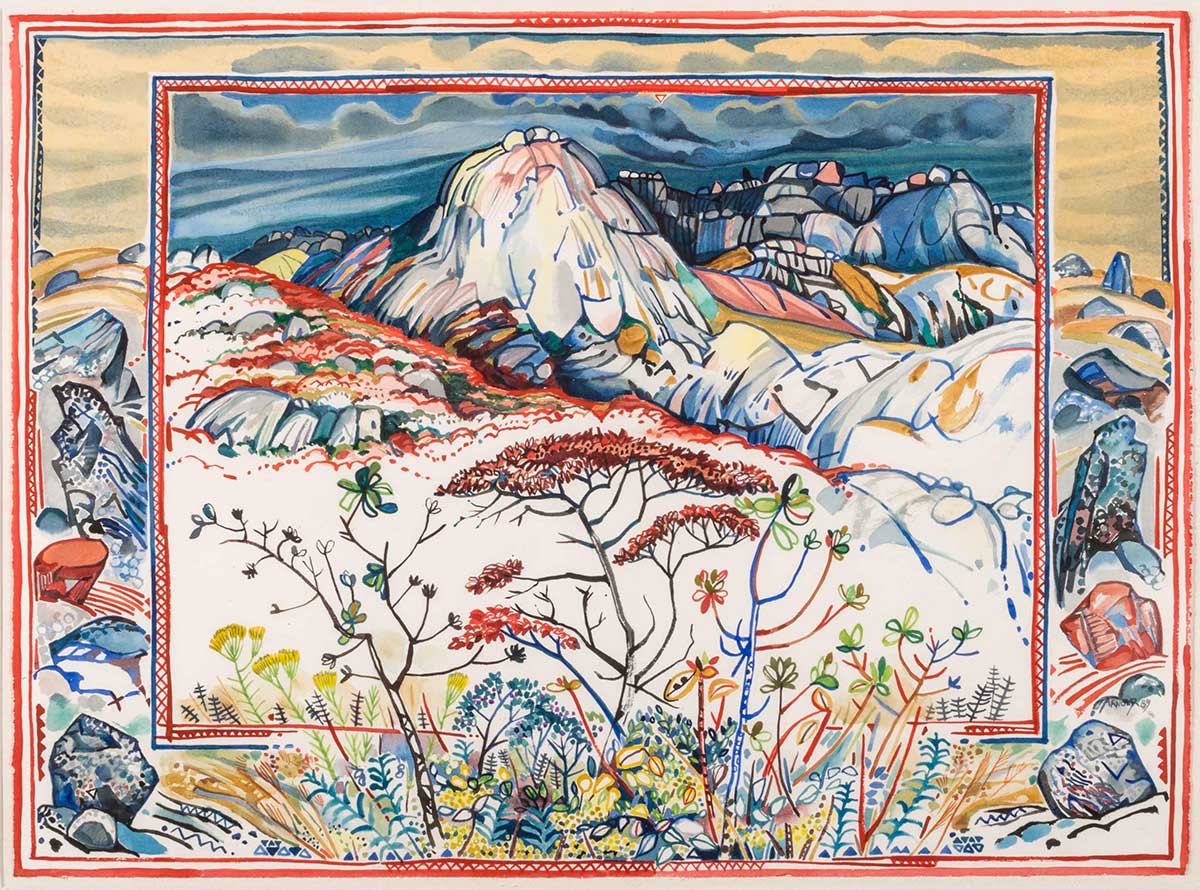
A new generation of woman artist begins to emerge in the late 1970s. Marion Arnold was one such painter who like Maggie Laubser began to break the mould in subtle ways. Using the traditions of still life and landscape painting, as well as engaging with the “feminine” medium of watercolour Arnold developed a pictorial language which referenced her positioning as a woman artist whilst using familiar products of the curio industry to provide a critical narrative of the dominant European conventions of landscape and still life painting. Judith Mason is another such unflinching woman who takes on emotionally charged subject matter with a highly personalised vocabulary. Mason has asserted that her images are derived from her experience as a woman. Taking this into account her imagery which at first seems obscure and hermetic begins to reveal a comprehendible narrative.
Complementing the focus on Women artists is a selection of works by celebrated painters and sculptors representing women as subject. The representation of woman has remained a central part of the Western paradigm of artistic production and overtly controlled and managed by men over centuries. This control has from time to time been seriously contested most severely so at the onset of “Postmodernism” when the Feminist movement made a decidedly radical turn particularly in the sphere of the arts. The feminist offense on patriarchal visual culture advanced beyond the critique of social conventions of feminine and masculine imagery, the objectification of the female body, to dissection of the family and sexual identities more broadly. Despite this radical critique images of woman remain a central part of the western artistic vocabulary whether created by women or men.
The selection presented by WALL is diverse in artists and eclectic in style. A common thread is the representation of a singular figure or portrait of a woman. A simple head of a loved one by Lucas Sithole contrasts resolutely with the playful elegance of the abstracted Ndebele ‘Prinses’ by Coert Steynberg which echoes the hieratic figures conjured up by Alexis Preller. Robert Hodgin’s painting ‘The Bust Stop’ has as subject the everyday image of a woman waiting but transforms the bus stop into a throne and the figure into imperious “queen”. Cecil Skotnes similarly elevates his images of women by pairing down and linear framing them similar to Greek icons.
Concluding the selection is a dramatic painting of a “bride” by Christo Coetzee. The image is enticing in its ambiguity with the subject presented as a possible real bride for a suitor, yet its ethereal rendering of a ghostly doppelgänger seems to indicate a more arcane meaning.